The fall of Kidal to a coordinated offensive by the Azawad Liberation Front (FLA) and the jihadist coalition Jama’at Nusrat al-Islam wal-Muslimin (JNIM) in late April 2026 is far more than a battlefield reversal. It is a moment of profound symbolic and structural significance, one that lays bare the fundamental fragility of a military regime that has governed Mali through coercion, nationalist performance, and external dependency since August 2020.
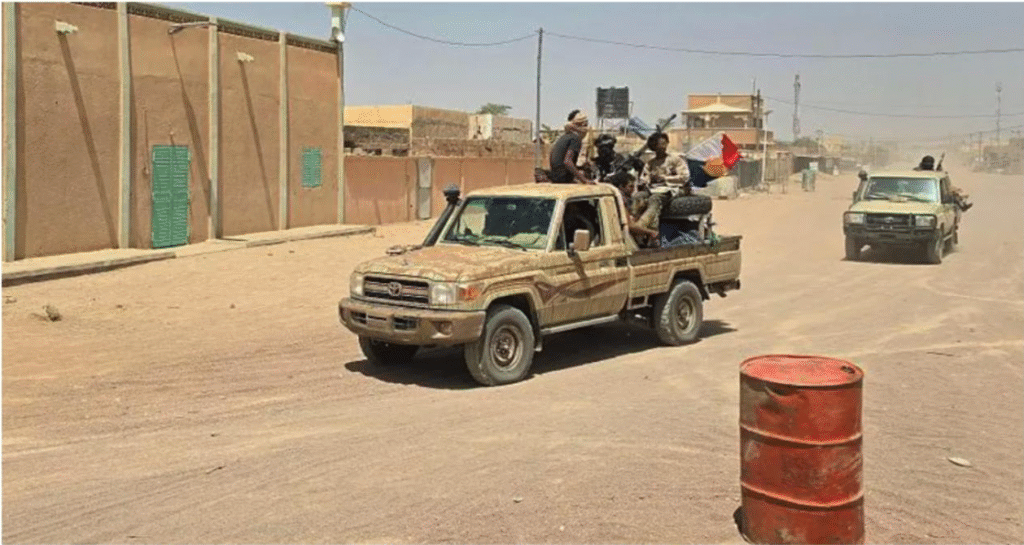
Note: The Russian African Corps and Malian military reached a concession with the FLA Separatists (in the picture) to vacate Kidal
Image Source: Okafor & Khalil (2026)
To understand what the loss of Kidal means, one must first understand how it was won. Colonel Assimi Goïta came to power following two coups in 2020 and 2021, pledging a transition to democratic governance by 2022, a promise that has never been fulfilled (Korotayev & Khokhlova, 2022). In the absence of electoral legitimacy, the junta constructed an alternative basis for authority: the narrative of military reconquest. Goïta backtracked on promises of elections, organised opaque national consultations, and progressively extended the transition timeline under pressure from ECOWAS. Crucially, in June 2025, Mali’s Council of Ministers adopted a bill revising the Transition Charter to grant Goïta a five-year renewable mandate, with no elections required, amid a dissolution of political parties and a spike in activist kidnappings (BBC Africa, 2025). Security performance, not democratic consent, became the regime’s primary claim to power.
The recapture of Kidal in November 2023, achieved with decisive support from the Russian Africa Corps,constitutes a key centrepiece of this narrative. The violence in Kidal in November 2023 marked some of the most severe active conflict between government and rebel forces since the 2015 peace deal, precipitated by competition for control of former UN bases after the withdrawal of UN MINUSMA, which was terminated by the UN Security Council in June 2023 (IEP, 2025). It was framed as proof that the junta’s expulsion of French forces and embrace of Russian partnership had unlocked a new era of Malian military capability(African Defense Forum, 2026). ACLED’s Héni Nsaibia is direct in his assessment of what the city’s loss therefore represents: it is “a major strategic setback for the Malian regime and their Russian Africa Corps partners,” and given the 2023 recapture’s centrality to the regime’s “rise to power” narrative, its reversal strikes at the very legitimacy architecture the junta had built (Nsaibia, 2026).
The Russian dimension deserves particular scrutiny. Power in Mali is concentrated around Goïta’s junta, with authority rooted less in electoral legitimacy than in military command, institutional control, and the promise that armed rule can restore order where civilian government had failed. Russian forces have been instrumental in sustaining that promise (Gonzalez, 2025)—yet the April 2026 offensive exposed the limits of this arrangement. As Nsaibia observes, “Russian and foreign involvement cannot resolve the structural and political challenges at the centre of the Sahelian insurgency.” External military partnerships can augment firepower; they cannot manufacture political legitimacy or address the ethnic marginalisation and governance grievances that animate both Tuareg separatism and jihadist recruitment across the Sahel.
The strategic consequences are cascading. JNIM’s announced blockade of Bamako threatens to compel the armed forces to concentrate resources on capital defence, further vacating peripheral territories and deepening the vicious cycle of state retreat and insurgent consolidation. The killing of Defence Minister Sadio Camara in the Kati truck bombing on 265April 2026 removes a key figure at a moment of maximum institutional stress. With withdrawals confirmed also from Ber and Tessit, what Nsaibia describes as “a partial collapse in the ranks of the Malian armed forces” is no longer a speculative risk — it is a documented trajectory (Egbejule, 2026).
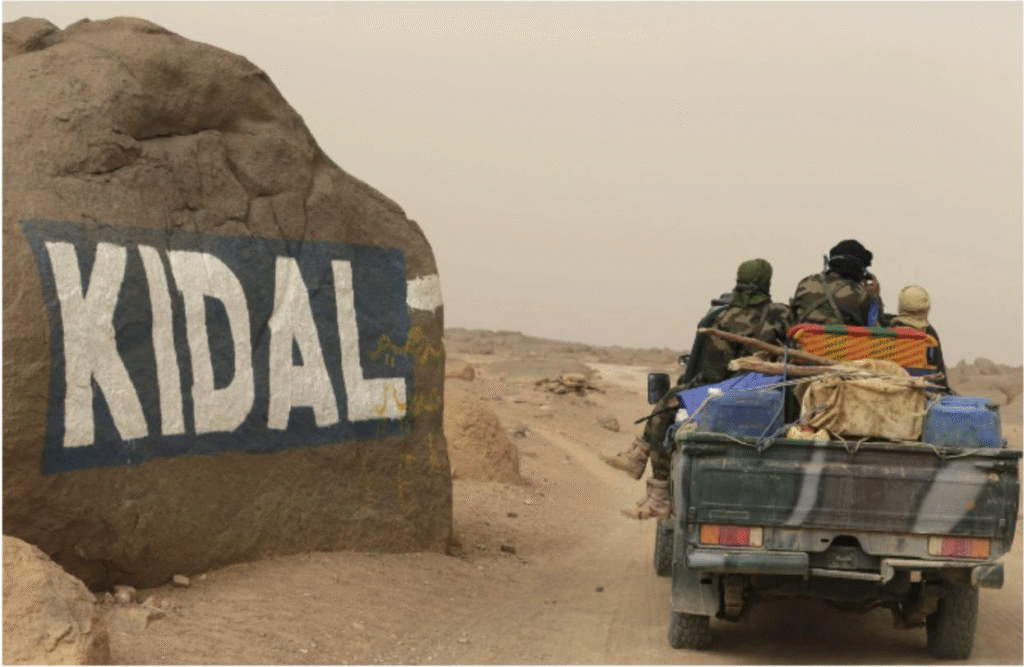
Note: Kidal is in Northern Mali, on the Southern fringes of the Sahara desert
Image Source: The African Report
The fall of Kidal, in sum, is the moment Mali’s military government confronts the consequences of substituting performance theatre for substantive governance. A regime that suspended democracy in the name of security has now lost the security argument too. What remains and what will define Mali’s immediate future is whether the political cost of this collapse accelerates a negotiated settlement, deepens authoritarian retrenchment, or precipitates yet another cycle of institutional rupture in a country that has now endured three coups in a single decade.
Funding
This work is part of the ASCEND Climate Sahel synthesis team at the University of Cape Town, an initiative jointly funded by UK aid through the Foreign, Commonwealth and Development Office, the International Development Research Centre (IDRC), Canada, and by the Ministry of Foreign Affairs of the Netherlands as part of the CLimate Adaptationand REsilience (CLARE) research programme and Step Change initiative. The views expressed herein do not necessarily represent those of the UK government, the government of the Netherlands, IDRC or its Board of Governors.”