The Climate Sahel team comprises 13 early-career scholars collaborating under the mentorship of a seasoned expert, Christophe Béné, at the Alliance of Bioversity International and CIAT. The team brings a diverse background in natural and social science background to synthesize and understand the trends and patterns in climate events, conflicts dynamics, and migration patterns in the Sahel. Through ASCEND, the team is organised to have a total of four in-person meetings at the University of Cape Town’s D-school, designed to accommodate and support group/teamwork. This also includes support on knowledge brokering and sharing strategies from the Climate and Development Knowledge Network (CDKN). The Sahel team is meeting again in April 2026 for their third in-person meeting to discuss programme and next direction in their research synthesis work.
What’s the Climate Sahel Team doing?
As climate events and their cascading effects continue to shape socioeconomic trajectories across the Sahel, the need for effective and evidence-based policy solutions has become increasingly pressing. In response, theClimate Sahel team have been working collectively, both remotely and through a series of in-person engagements hosted at the University of Cape Town, to synthesise diverse datasets to better understand climate vulnerabilities, and socioeconomic dynamics in the region. The team’s first in-person meeting held in April 2025, established a shared analytical framework to guide the systematic extraction and review of secondary data to ensure a methodologically sound and rigorous synthesis process. This was followed by a second in-person meeting in December 2025, which provided an opportunity to take stock of the progress, refine thematic focus areas, and strengthen coordination across different axes of work. Between and beyond these team meetings,members have undertaken an extensive process of sourcing and curating relevant peer-reviewed and grey literature from diverse databases and repositories. Team members meet weekly in smaller thematic groups and convene monthly as a full synthesis team to review progress and recalibrate next steps. So far, the team is focused on understanding the different trends and patterns of climate events, including aspects of conflict dynamics and migration drivers and impacts in the Sahel.
What are the Preliminary Findings Saying?
Although not yet concluded, the preliminary findings from the synthesis work done so far are staggering.
a) Climate events: As for climate events, the synthesis reveals a shifting hazard landscape across the region. Prior to 2015, climate events appeared more diverse and frequently documented, including droughts, floods, rainfall variability, and heatwaves. However, post-2015 patterns suggest a more uneven distribution of reported events, with drought remaining the most persistent and dominant hazard reported across the region. This shift raises important questions about both evolving climate dynamics and gaps in reporting and classification.
b) Conflict dynamics: The evidence assembled to date points to a complex and evolving conflict landscape in the region. Violent extremism remains the most salient and widely reportedly form of violence.However, this is only a fragment of the picture. Other forms of conflicts, particularly those driven by political contestation and environmental pressures, are increasingly coming into view. Climate-related stressors, such as recurrent drought and intensifying resource scarcity, are not operating in isolation; rather, they interact with existing governance challenges and socio-economic vulnerabilities, contributing to the emergence and escalation of localised conflicts.
c) Migration patterns: Migration emerges as a central outcome of these intersecting pressures, but it cannot be reduced to a simple dichotomy of voluntary versus forced movement. Instead, it reflects a spectrum of adaptive strategies shaped by livelihood insecurity, exposure to violence, and environmental stress. The dominant patterns are largely regional and often circular, with individuals and households movingwithin and across neighbouring countries in response to shifting conditions. A key insight from the evidence is that climate-related events rarely act as a direct trigger of either conflict or migration. Their influence more often indirect, operating through intermediate pathways, particularly by undermininglivelihoods and intensifying competition over scarce resources. Similarly, migration is not simply a response to crisis, but also a deliberate, if constrained, strategy for managing risks. These adaptive choices, however, are shaped and often constrained by entrenched structural inequalities and weak state institutions.
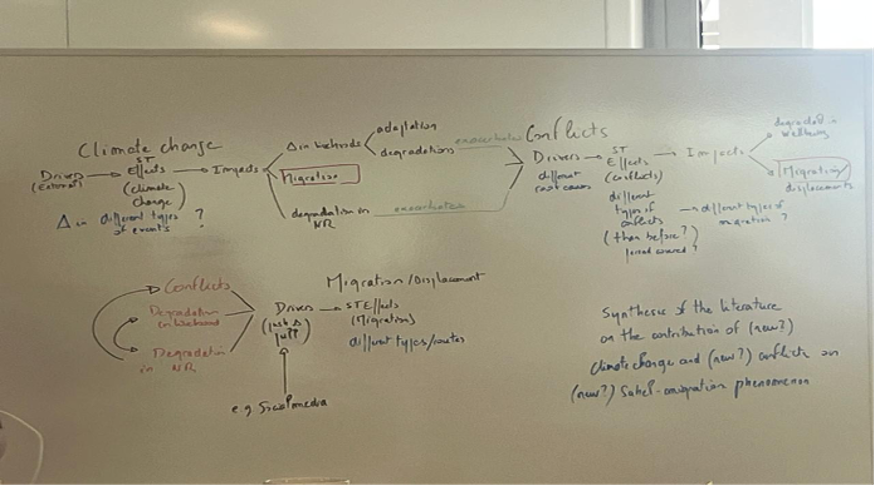
Fig 1: A whiteboard snapshot showing the climate-conflict-migration synthesis framework (conceptualised by Christophe Béné), adopted by the team during the first in-person workshop in Cape Town (April 2025).
What’s next for the team?
As the team prepare for their third in-person meeting, the focus is on moving from analysis to synthesis and from synthesis to impact. The priority is to consolidate and validate findings across all thematic axes, namely, climate, conflict, and migration, while ensuring consistency and analytical robustness. Building on this, the team will further develop and refine its conceptual framework, aligning findings within a unified analytical lens that captures the dynamic interconnections between these axes. This step is critical to move from evidence-based synthesis to explanatory insight. The team will also focus on discussions and integration of data into meaningful results. This result will highlight cross-cutting patterns, validate key assumptions, and present a coherent narrative of the climate–conflict–migration nexus in the Sahel. Lastly, the team will prioritise knowledge brokering and the development of output in collaboration with CDKN. This will involve translating complex findings into accessible, policy-relevant formats, alongside identifying effective strategies for dissemination and stakeholder engagement.
Sharing Evidence Beyond the Project
In terms of dissemination, the Real Life Research Institute (RLRI) – Africa Program has been closely following the progress of the Climate Sahel team, given its connections to key members of the synthesis group. As part of its ongoing Africa-Canada webinar series, which connects researchers and practitioners across both regions, RLRI Africa Program will feature two core members of the team as speakers in its upcoming May2026 webinar. The webinar focuses on “Rethinking Climate Adaptation in Africa.” While the event is not exclusively dedicated to the BAOBAB synthesis project, it directly engages with emerging insights from the team’s work. The webinar aims to address a critical gap in current climate adaptation approaches. Despite growing investments in adaptation, many interventions remain externally driven, standardized across contexts, and insufficiently grounded in local realities and lived experiences.
At the same time, the session will explore how misinformation and disinformation are increasingly shaping climate narratives, undermining trust in both scientific evidence and Indigenous knowledge systems. By bringing together synthesis researchers, experts on climate misinformation, and local civil society perspectives,the webinar creates a unique space for dialogue. Importantly, this platform connects the project’s research insights to African and Canadian practitioners, fostering cross-regional exchange and advancing more context-responsive, trusted, and effective approaches to climate adaptation.
This work represents a shift from fragmented analysis to integrated, policy-relevant synthesis. As the team moves forward, the goal is not only to understand the complex dynamics shaping Climate Vulnerabilities, Conflicts, and Livelihood in the Sahel, but to ensure that this understanding informs practical, context-sensitive, and inclusive development responses.
BAOBAB synthesis research teams are supported through the BAOBAB project, which is jointly funded by UK aid through the Foreign, Commonwealth and Development Office (FCDO), the International Development Research Centre (IDRC), Canada and by the Ministry of Foreign Affairs of the Netherlands as part of the Climate Adaptation and Resilience (CLARE) research programme and Step Change initiative.