What our research says about building sustainable peace
In our recent study, however, we find that this framing is incomplete and potentially misleading for policy. Drawing on panel data from ten Sahelian countries as defined by the United Nations Integrated Strategy for the Sahel (UNISS), our research asks a different question: through which pathways do climate stress translate into conflict—and how do these pathways reinforce one another over time? Our findings suggest that climate change in the Sahel works less as a direct trigger of violence and more as a structural threat multiplier, operating primarily through food insecurity and internal displacement, which then feed back into conflict dynamics.
Figure 1: Conceptual framework examined in this study
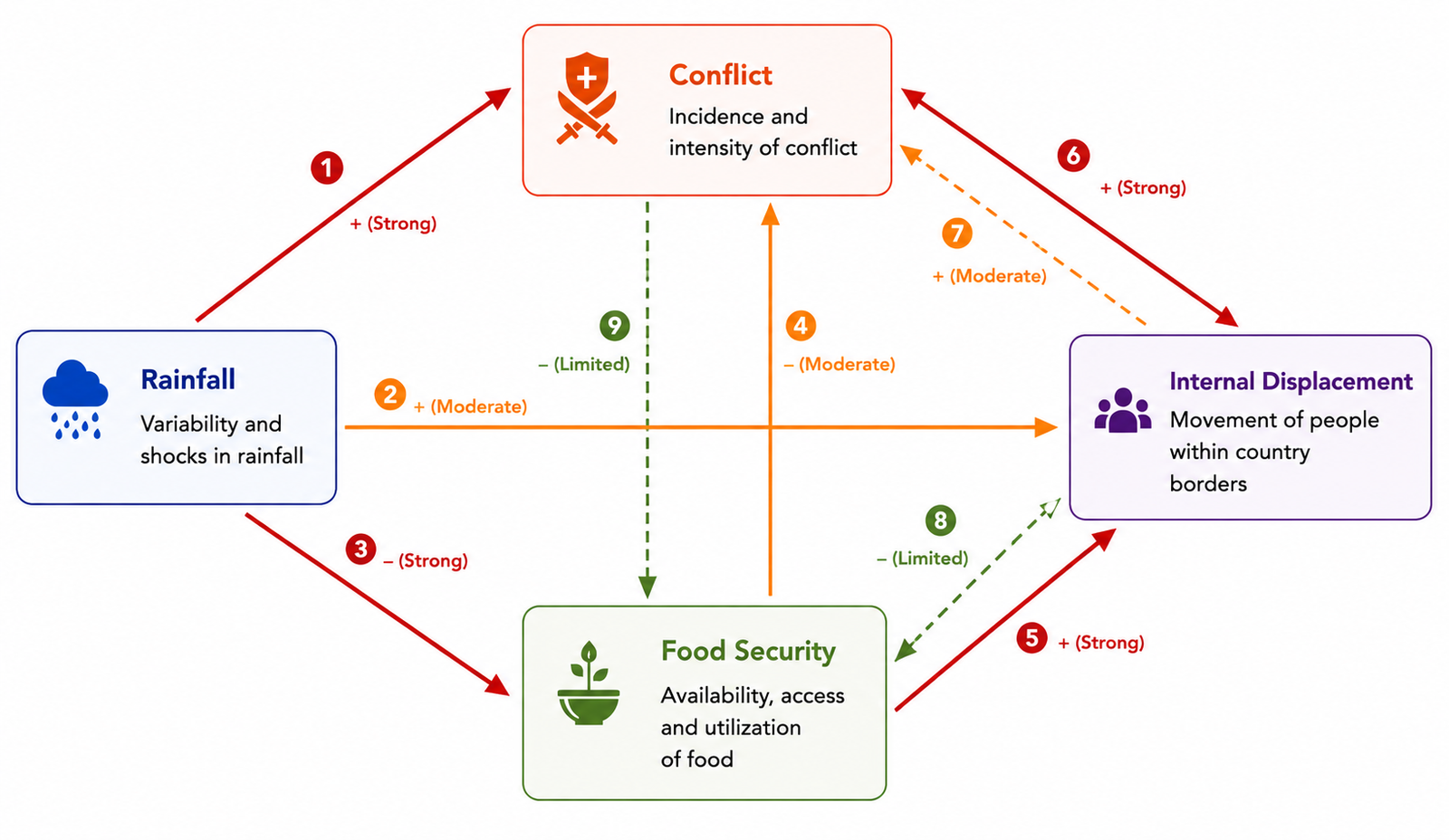
Note: Arrows indicate the direction of influence hypothesized and tested in this study Pathway strength reflects statistical significance: ***p<0.001, **p<0.05, *p<0.01 The model controlled for global shocks, institutions, geography, colonial history, population pressure among other covariates in a manner that satisfied the identification criteria
Why we looked beyond direct climate-conflict links?
Much of the existing climate–security debate relies on single‑equation models that relate rainfall shocks or temperature anomalies directly to conflict events. While informative, such approaches obscure the political‑economic mechanisms that transform environmental stress into violence. In the Sahel, contextual factors matter. These include the nature of livelihoods which is predominantly agrarian, the region’s weak state capacity, and the widespread displacement. We therefore developed a simultaneous system of equations that treats food security, internal displacement, and conflict as jointly determined outcomes, rather than isolated covariates. This allowed us to capture feedback loops that standard approaches tend to miss. We estimated this system using two complementary simultaneous estimation techniques, namely: Three‑Stage Least Squares (3SLS) and Structural Equation Modelling (SEM).
Water stress: A silent but salient driver
One of our most consistent findings is the central role of water stress. Rather than short‑term rainfall shocks, it is chronic pressure on freshwater resources that significantly increases both conflict incidence and food insecurity in the Sahel. The finding is not far-fetched considering the 2023 Global Water Assessment report which shows the Sahel and Sub-Saharan Africa as a region with severe water insecurity issues, often scoring zero out of ten in most of the categories assessed (see Note in Figure 2).
Figure 2: National water security mapped globally, based on a score of 100
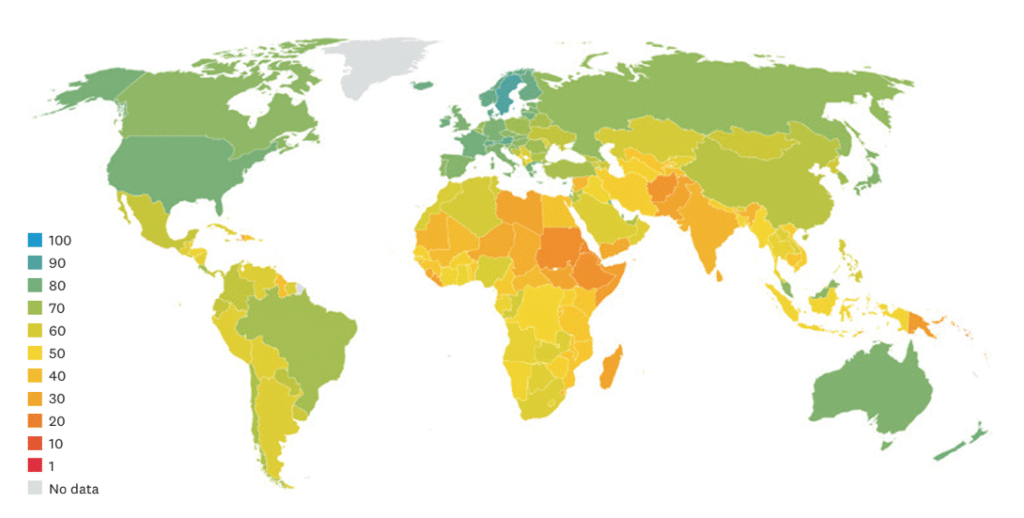
Source: Global Water Security 2023 Assessment
Note: The global map of national water security is based on an index ranging from 1 to 100. The index is computed from the aggregate scores of ten components, each measured on a scale of 1 to 10: (1) access to safely managed drinking water, (2) sanitation, (3) public health outcomes measured through WASH-attributable mortality, (4) water quality, (5) water availability, (6) water value, (7) water governance, (8) human safety, (9) economic safety, and (10) water resource stability. Higher scores indicate greater levels of national water security.
This distinction is crucial for policy. Episodic droughts often receive attention through emergency responses, yet long‑term degradation of water availability driven by (1) population pressure, (2) competing water uses, and (3) weak governance, quietly erodes livelihoods and heightens grievances. Our results show that rising water stress directly increases conflict while simultaneously reducing food production, emphasizing water governance as a core peacebuilding concern rather than a technical sectoral issue.
Food security as a conflict pathway and a feedback loop
Food insecurity emerges in our analysis as a key transmission mechanism linking climate stress to conflict. Declines in food production significantly increase violent conflict, lending empirical support to long‑standing arguments that livelihood shocks heighten economic grievances and resource competition in fragile settings.
At the same time, we find strong evidence of reverse causality: conflict itself undermines food security by disrupting agricultural activity, displacing farming households, destroying assets, and fragmenting markets. This bidirectional relationship means that food insecurity and conflict form a self‑reinforcing loop. Once violence escalates, it deepens hunger, which in turn raises the risk of further violence.
From a policy perspective, this challenges the tendency to treat food security exclusively as a humanitarian outcome. In the Sahel, food production is not peripheral to stability—it is central to it.
Internal displacement: More than an outcome
Internal displacement plays an equally pivotal role in the system we identify. Our findings confirm that conflict strongly drives displacement, but they also show that displacement itself increases subsequent conflict. Large inflows of internally displaced persons place pressure on land, water, and public services in host communities, intensifying competition and social tension in already fragile environments.
An unexpected but important result concerns the relationship between food security and displacement. We find that improvements in food production can, in certain contexts, increase displacement. This does not imply that food security is undesirable. Rather, it reflects what migration scholars describe as a “mobility‑enabling” effect: when livelihoods improve, some households see the income gain as temporary and hence a means to move away from insecure or environmentally stressed areas. This complexity highlights the importance of anticipating mobility responses when designing food and climate interventions.
What This Means for Policy
The overarching implication of our research is that security‑first approaches are insufficient for achieving durable peace in the Sahel. Conflict in the region is not merely a failure of policing or counterinsurgency; it is deeply embedded in livelihood systems shaped by climate stress, food insecurity, and displacement. Effective peacebuilding strategies must therefore integrate:
- Climate adaptation and water governance, particularly investments that reduce long‑term water stress;
- Resilient food systems, not only to address hunger but to mitigate conflict risks;
- Displacement governance, including support for host communities and early‑warning mechanisms that prevent climate and food shocks from cascading into violence.
Treating these domains as humanitarian or development “add‑ons” risks perpetuating the very instability they are meant to alleviate.
Concluding Reflections
Our findings reinforce a broader shift in climate–security research away from monocausal narratives and toward systemic understandings of risk. In the Sahel, climate change does not ignite conflict in isolation. It reshapes livelihoods, forces movement, and weakens already fragile political and social systems, thereby creating conditions in which violence becomes more likely. Breaking this cycle requires integrated policy responses that recognise food security and displacement not as secondary consequences of conflict, but as core components of peacebuilding. For policymakers working across climate action (SDG 13), zero hunger (SDG 2), and peace and state capacity (SDG 16) agendas, the message is clear: addressing one dimension in isolation is no longer an option.
Funding
This work is part of the ASCEND Climate Sahel synthesis team at the University of Cape Town, an initiative jointly funded by UK aid through the Foreign, Commonwealth and Development Office, the International Development Research Centre (IDRC), Canada, and by the Ministry of Foreign Affairs of the Netherlands as part of the CLimate Adaptation and REsilience (CLARE) research programme and Step Change initiative. The views expressed herein do not necessarily represent those of the UK government, the government of the Netherlands, IDRC or its Board of Governors.”