
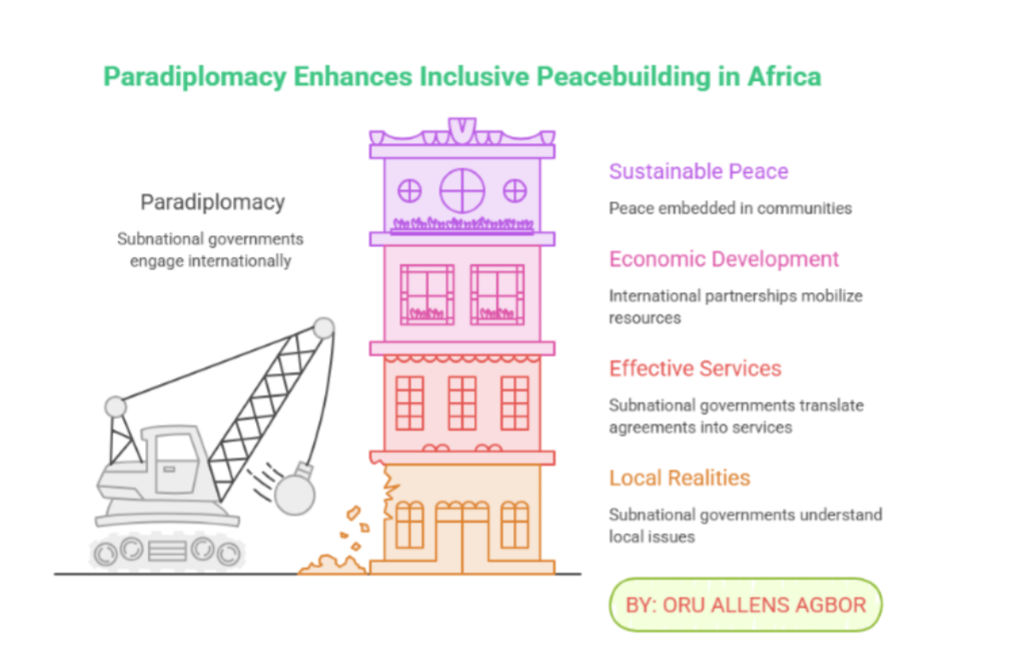
Paradiplomacy refers to the international engagement of subnational governments: regions, provinces, municipalities, districts and other devolved authorities. It does not replace national diplomacy but complements it by creating additional channels for international cooperation.
The idea is not entirely new. Scholars such as Ivo Duchacek and Panayotis Soldatosexamined decades ago how subnational governments could become actors in international affairs. Later, Aldecoa and Keating’s Paradiplomacy in Action helped establish paradiplomacy as an important field. Cornago’s work on the normalization of sub-state diplomacy showed its growing institutionalization in the Western world, particularly in regions such as Quebec and Catalonia.
This blog explores how African settings test the concept of paradiplomacy and argues that peacebuilding in Africa should involve the institutions of governance closest to citizens in networking with other regional and international actors to build the foundations and conditions needed for addressing the root causes of violent conflicts and sustaining peace in communities.
From institutional inclusivity to locally-led peacebuilding
Much of the discussion around inclusive peacebuilding focuses on who participates. This is necessary, but perhaps not sufficient. Inclusion should go beyond ensuring that actors such aswomen and youth have a seat at the table. We should also think about institutional inclusivity.
This means ensuring that the different levels of governance institutions that shape people’s everyday lives play meaningful roles, including interfacing with international actors toadvance development and build peace. This is not to compete with or weaken national governments. On the contrary, it is based on the recognition that development and peace strategies work better when connected to local institutions and realities, as the work on multi-level governance by Hooghe and Marks suggests.
While paradiplomacy in this sense appears to align with decentralization, Crawford and Hartmann’s Decentralisation in Africa shows that decentralization is neither a shortcut to development nor an automatic solution to poverty and conflict. The idea of paradiplomacy is therefore not to simply decentralize peacebuilding but to build the capacities of subnational governments to engage directly and cooperate meaningfully with different governance levelsinternationally in order to advance greater peace and security for local communities in Africa.
Why this matters for peace
The African Union’s Agenda 2063, adopted in 2015, presents an ambitious vision of an integrated, prosperous and peaceful Africa. Its peace and security ambitions are reinforced by the African Peace and Security Architecture (APSA), which provides the continental framework for preventing, managing and resolving conflicts. These frameworks can only be effectively operationalized through locally-led efforts. This is where subnational governments come in because they are closer to the realities that shape everyday violence and daily peace.
A national peace agreement, for instance, may set political arrangements, but local authorities frequently have to translate them into services, infrastructure and economic opportunities to ground peace. As Lederach’s work on peacebuilding reminds us, sustainable peace requires long-term processes involving multiple levels and actors, not only national elites. Similarly, Mac Ginty’s work on everyday peace highlights the need for local strategies, cooperation and partnerships to navigate conflict.
A note-worthy example of paradiplomacy for peace and security is offered by border communities in Africa. Along the Niger-Burkina Faso and Mali-Burkina Faso corridors, for instance, inter-municipal committees and informal agreements have sustained border markets, transhumance routes and informal networks for conflict resolution and communal policing. This shows that regional networking within the framework of paradiplomacy, with overseas partners or neighbouring towns, can sustain peace-relevant cooperation without threatening national sovereignty.
The missing economic dimension
Peacebuilding also needs to take the political economy of conflict seriously. Where communities face unemployment, weak infrastructure and inequality, political grievances become harder to resolve. Galtung’s work on peace, conflict and development reminds us that peace cannot be separated from the structural conditions that reproduce violence. The African Economic Outlook 2024 called for reform of the global financial architecture, and the World Bank’s 2024 analysis of fragility, conflict and violence estimates that by 2030, 59% of the world’s extremely poor people could live in fragile and conflict-affected situations. This is where economic paradiplomacy deserves greater attention.
Subnational governments can use international partnerships to mobilise knowledge, investment and development cooperation around local priorities. For African regions and cities, such partnerships, which the World Development Report 2020 links to trade and value chains, can support local employment, infrastructure and resilience. These are not merely development concerns; they are foundations of sustainable peace.
Rethinking inclusive peacebuilding
The United Nations’ work on peacebuilding and sustaining peace and the UNDP and Inclusive Peace study on implementing peace agreements both underline inclusion and local ownership. If peace is experienced locally, then local and regional governance institutions in-country cannot remain peripheral to the peace architecture. In Africa, this means connecting subnational governments and decentralized units to direct cooperation with foreign partners on peace, security and economic development.
This paradiplomacy approach recognizes that peace moves beyond physical safety and can also be experienced through investments that boost access to schools, healthcare, infrastructure, jobs, markets, and public services acting as foundations for peace. The objective is to therefore foster complementary channels of cooperation that make peacebuilding more inclusive of local needs, well-grounded in subnational governance structures, responsive to local realities, and ultimately sustainable. For peace becomes sustainable when it is embedded in the local institutions, economies, and communities where people live.